Call Today
214 226-6007

Brick Repair
Mortar Cracks
Arch Entry Repair
Chimney Repair
Water Leaking thru Bricks
Masonry Cleaning
Sealing
Expansion Seams
Free Estimate
History/Researh
Links

Miscellaneous Masonry Products
Building Stone
1) Geological Source
2) Quarrying
3) Classification By Form And Type
4) Physical Properties
5) Finishes
Introduction
Building stone must be included among the oldest building materials known to man. Throughout recorded history, stone has been regarded as the preferred material in the construction of permanent buildings. This is doubtless due to its unique qualities --beauty, permanence, workability and acessibility, among others. It was, in fact, the predominant material used in the construction industry prior to the turn of the twentieth century.
Since that time, stone has assumed a new role in the construction field. Because the height of buildings continued to increase, it became necessary to look more closely at the mass of the materials that went into the basic structures. Stone began to be developed as a facing material, rather than as a basic structural material.
In this new role it is used as a veneer, in comparatively thin slabs, over a building frame of reinforced concrete or steel. In this way, the inherent qualities which initially brought stone into prominence -- beauty, permanence, adaptability and economy -- are used without having to contend with the great mass imposed by a solid stone structure.
1. Geological Source
An understanding of the geological origin of building stones, their structure and composition may be an aid in choosing stone that will fit properly into the regional setting and with the particular architectural design proposed for a specific building. Such an understanding may also be helpful in the selection or rejection of a particular stone proposed for a job and in the correct placing of each selected unit during the stone-laying process.
Rock may be divided into three broad categories depending on its geological origin; namely, sedimentary, igneous and metamorphic.
1.1. Sedimentary rock was formed by the action of water. This action may have resulted either in the depositing of minerals at the bottom of a body of water through sedimentation or in depositing them on the earth's surface. The latter action takes place when water flows to the surface from the interior of the earth, bringing dissolved minerals that are deposited on the surface by evaporation.
Sedimentary rock, like the other groups, has extensive range of composition and character, but for our purposes it is possible to divide it into four groups. These are: rudaceous rock, which includes breccia and conglomerate; arenaceous rock, which includes sandstone, arkose and quartzite; argillaceous rock, largely shale; and calcareous rock, which includes a number of limestones.
1.2. Igneous rock was formed by the cooling and consolidation of molten matter that was brought to the earth's surface by volcanic action. It may be divided into three main rock types: volcanic, which includes pumice, obsidian, rhyolite, andesite and basalt; hypabyssal, which includes felsite, quartz, porphyry and dolerite; and plutonic, encompassing granite, diorite and gabbro.
1.3. Metamorphic rocks are distinctive new rock types that have been changed from their original igneous or sedimentary structure by the action of extreme pressure, heat, moisture, chemical fluids or various combinations of these forces. There are a great many of these metamorphic rocks, but only two groups have much significance as building stone, namely the slates and the marbles. A slate is a rock derived from argillaceous sediments or volcanic ash by metamorphism, It has very distinct cleavage linas along planes that are quite independent of the original bedding. A marble is a granular limestone, recrystallized by heat or pressure.
1.4. Rock may also be classified according to its composition. A great many minerals occur in rock formations throughout the world, but stone used for construction purposes generally comes from rock that falls into one of three classifications: rock that contains mostly silica, rock composed largely of silicates and rock containing calcareous minerals.
Silica, which is the oxide of the element silicone, is the most abundant mineral on the earth's surface. It is the chief ingredient of sand and is found in most clays and in a number of the building stones. Free silica, of which crystalline quartz is the most common form, either alone or in combination with other elements, comprises about 60 percent of the earth's crust.
Silicates are minerals that are compounds of silica and one or more other elements and are the main ingredients of igneous rock. The quantity of silica in igneous rock varies from about 30 to 80 percent and is sometimes used as a method of classification of such rock. For example, igneous rock containing more than 66 percent silica is known as acid igneous rock, while basic igneous rock contains between 30 and 52 percent silica, with no free quartz. Intermediate igneous rock has a silica component of between 52 and 66 percent.
Silicate minerals include feldspar, hornblende, mica, and serpentine. Feldspar is a silicate of alumina in combination with lime or potash. Depending on the combination, colors may be red, pink or clear. Hornblende is a silicate of alumina with lime or iron. It is a tough, strong mineral appearing in green, brown and black cyrstals. Mica is mostly silicate of alumina but may occur in combination with other minerals such as iron or potash. It appears in soft, usually clear crystals that split easily into flat flakes. Serpentine, which is a silicate of magnesia, often appears in combination with lime. It is light green or yellow in color and has no readily defined planes along which it will split.
Included among the most common calcareous minerals are calcite, which is basically carbonate of lime and dolomite, a carbonate of lime in combination with varying amounts of magnesia.
2. Quarrying
The removal of stone from its natural bed is carried out by a process known as quarrying. The method of quarrying will depend to a considerable extent on the kind of stone being removed and the nature of the particular stone involved.
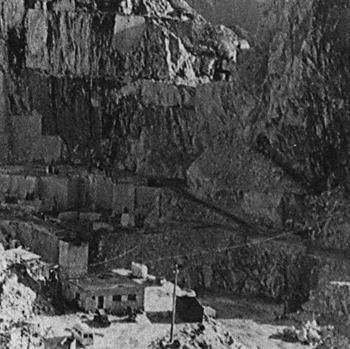
Quarry marble
Some stone deposits have natural horizontal divisions (i.e., they are stratified horizontally), and the horizontal lines of demarcation between the strata are known as bedding planes. Other types of stone will have more visible vertical separations, which are know as cleavage lines. In some stone, both are apparent.
2.1. These natural planes of separation are an aid in removing the stone from its natural location.
In one method of quarrying, holes are drilled close together at right angles to the bedding planes, cleavage lines, or both and wedges are driven into the holes to split the rock along the drilled line.
The layout for another method that involves quarrying on a large scale is illustrated. After the overburden has been removed, a channel machine or a rock saw is brought in to ouline the boundaries of the quarry.
The channel machine is a heavy machine with a pneumatically-operated chisel mounted on one side which cuts a narrow channel into the rock, while the rock saw is simply a huge circular saw with diamond-studded teeth. These machines, traveling on temporary tracks, cut a single or double cut, depending on the subsequent method of operation, up to 3 m (10 ft) deep, down each side and down the center of the area of exposed stone.
When a double cut is made, the material between the two cuts is split into blocks and removed to leave a canal, the depth of the cuts, down the sides and center of the quarry.
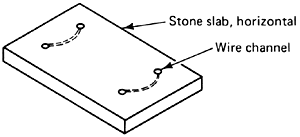
2.2. Then, using the channel machine, rock saw or a wire saw, lateral cuts are made and the long blocks thus produced are cut into convenient lengths and removed from the quarry bed for transportation and further processing.
A wire saw is a 6mm (1/4 in) diameter, endless wire, strung between pulleys which are mounted on a frame. The wire transports hard sand that acts as the cutting agent. It is when this method of cutting is used that the canals are required. The wire saw support frames are set in the canals, and the wire saw cuts across the span from side to center canal.
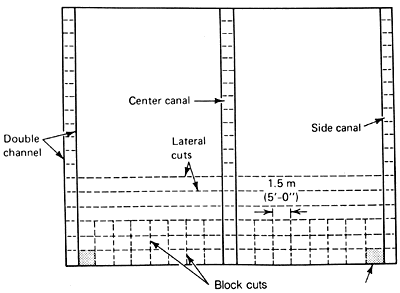
Diagram of limestone quarry layout
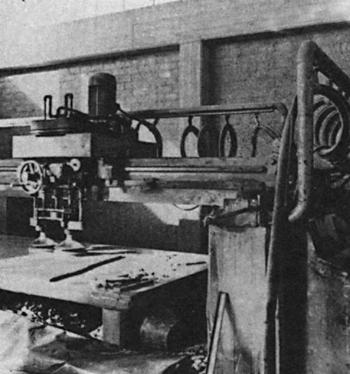
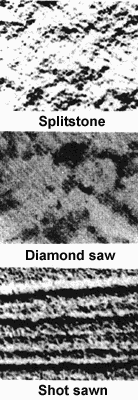
2.3 Finishing and preparation. The large blocks of stone from the quarry are taken to a mill where they are first passed through a gang saw that cuts them into thick slabs. Power saws (chat saws, shot saws and diamond saws) are then used to cut the slabs into pieces of the required dimensions.
Each piece is then given whatever surface treatment is required to produce the texture specified in the order. In some cases, the surface produced by the saw is all that is required. In other cases, planers, grinders, polishers or hammer and chisel are used to produce the desired texture.
Stones which are to be anchored to the building must be drilled either on the edge or the back, depending on their position. Those that have a special shape are produced by stone carvers, working with a hand-sized air hammer and chisel.
3. Classification By Form And Type
Stone for building purposes may be classified according to the form in which it is available commercially. These are: rubble (fieldstone), dimension (cut stone), flagstone (flat slabs) and crushed rock.
The stones which are most commonly used in modern building construction include: argillite, granite, limestone, natural lavas, quartzite, travertine, marble, schist, serpentine, sandstone and slate.
3.1. Rubble includes rough fieldstone that may simply have been broken into pieces of suitable size, or it may include irregular pieces of stone that have been roughly cut to size.
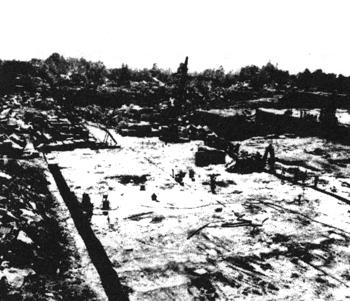
Canal along sides of stone bed
3.2 Dimension Stone makes up the largest portion of the stone used in building construction. It consists of pieces that have been cut to some specific dimensions and, in general, falls into two categories. The first consists of units of relatively small size, cut to various dimensions, and generally referred to as ashlar. This type of cut stone is used as a facing over a structural backup wall.
3.3 Flagstone consists of thin sheets of stone 12 mm (1/2 in) and up -- that may or may not have their face dimensions cut to some particular size. Such stone is used for flooring, patios, walks, and so forth.
3.4. Crushed stone consists of pieces varying from 10 to 150 mm (3/8 to 6 in) in diameter, It is used as coarse aggregate in the concrete industry and as a facing material for some architectural precast concrete curtain wall units.
3.5. Argillite. Argillite is a metamorphic rock, formed from clay, that normally has well-defined cleavage lines, It is produced as ashlar and rubble-facing stone, as floor tile and stair treads, wall base, coping stones, window stool and sills. Colors range from deep red to purple; a deep blue color with faint shades of green is common along with seam face colors of gray, buff, tan and russet.
3.6. Granite Granite is of igneous origin, composed of quartz, feldspar, mica and hornblende. It is generally a hard, strong, durable stone, capable of taking a high polish, so that finishes may vary from rough-sawn or natural surface to a mirror-smooth polished surface. Granite is produced as ashlar and rubble, wall panels, flooring tile, stair treads, flagstones, column facings, copings and sills and small regular or natural shapes used as facing for precast concrete facing panels.
3.7. Limestone. Limestone, a sedimentary rock, is one of the most popular building stones and has a wide variety of uses. There are three distinct types of limestone. Oolitic is a calcite-cemented calcareous rock, formed of shells and shell fragments from small aquatic creatures, and is noncrystailine in nature. It has no cleavage lines and is usually very uniform in structure and composition. Dolomitic is rich in magnesium carbonate and frequently somewhat crystalline in character, It has a greater variety of textures and is normally stronger than oolitic limestone in both compression and tension. Crystalline is composed largely of calcium carbonate crystals, with high compressive and tensile strength and smooth texture. The color is usually light gray.
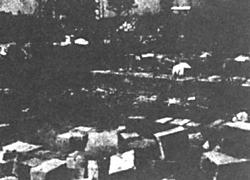
Limestone blocks removed from quarry bed
Some of the better known limestones are: Carthage and Miami Valley limestone, which are crystalline limestones; Kasota, Mankota, Winona and Niagara stone, which are dolomitic limestones; and Indiana limestone, Tyndallstone, Cordova limestone, shadowvein, cottonwood and goldenshell lime stones, which are oolitic limestones. Some of the oolitic limestones are unique in appearance, with the fossil shapes being clearly visible in the face of the cut stone.
Limestone uses include paneling, ashlar, flagstone, window sills and stools, copings, mantles and facings of all kinds.
3.8. Natural Lavas. The lavas that flowed from ancient volcanos have left rock deposits that, in some cases, have proven to be useful as building stone. A unique feature of many of them is their relative lightness; some may weigh only one-fifth as much as granite.
Some of the lightweight stones used in building construction include obsidian, corkstone and some scorias. Their composition is largely silica, with colors of charcoal, gray and tan.
Production is mainly in the form of rubble veneer, in thicknesses of from 25 to 100 mm (1 to 4 in), in random face sizes.
3.9. Travertine. Travertine is a sedimentary rock, made up largely of calcium carbonate, It has been formed at the earth's surface, in most cases, through the evaporation of water from hot springs.
Most of the production is in the form of small slabs that are used as an interior decorative stone because of their pleasing and unique texture.
3.10. Marble. Marble is another metamorphic rock, having been formed by the recrystallization of limestone and dolomite. There are a number of well-known types of marble, including carrara, onyx, numidian, Vermont, parian and brecciated marbles.
Marble has a very wide range of colors due to the presence of various oxides of iron, as well as silica, mica, graphite and carbonaceous matter that are scattered all through the rock in streaks, blotches or grains. Brecciated marbles are made up of small fragments embedded in a cementing material.
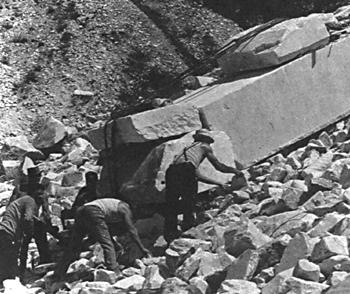
Marble being transported from quarry site
Some varieties of marble deteriorate readily when exposed to the weather and are suitable only for interior use. Others are quite stable and are suitable for exterior, as well as interior use.
Much of the marble produced for the building in dustry is in the form of slabs from 12 to 50 mm (1/2 to 2 in) in thickness, for use as exterior and interior wall paneling, column facings, flooring, counter tops and sanitary installations.
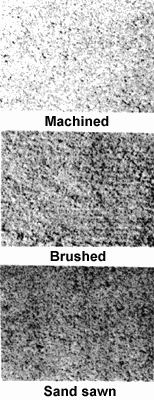
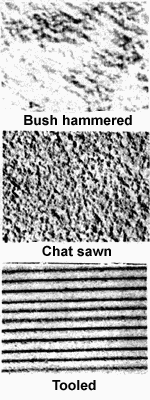
A variety of finishes are possible, depending on the particular marble being used. They include polished, honed, sand blasted, bushhammered, sawn and machine-tooled surfaces.
3.11. Schist. Schist is also a metamorphic rock, of foliated structure, that splits easily into slabs or sheets. Its composition varies depending on the basic material from which it was formed but, in most cases, the basic component will be about 85 percent silica, with iron magnesium oxides making up the remainder. Colors include red, gold, green, blue, brown, white and gray.
Rubble veneer and flagstone make up the greatest percentage of schist production; the veneer ranges in thickness from 50 to 155mm (2 to 61/8 in) and the flagstone from 20 to 40 mm (3/4 to 1 5/8 in).
Common uses include exterior and interior wall facings, fireplaces, sidewalks, patios and landscaping.
3.12. Serpentine. Serpentine is an igneous rock, so-called because it is largely made up of the mineral serpentine -- a magnesium silicate, It is dense and homogenous in structure, with a fine grain and no cleavage lines. Colors normally range from olive green to greenish black, but the presence of impurities in the rock may give it other colors.
Some types of serpentine are subject to deterioration due to weathering and are useful for interior work only. Black serpentine is highly resistant to chemical attack and is useful in situations where it is likely to come in contact with moisture-borne chemicals.
Most serpentine is produced in relatively thin slabs of from 20 to 30 mm (3/4 to 1 3/16 in) in thickness, that are used as paneling, window sill and stools, stair treads and landings.
3.13. Sandstone. Sandstone is a sedimentary rock, composed of grains of quartz cemented together with silica, iron oxide or clay; the hardness and durability of the particular sandstone depends on the type of cement. Other materials such as lime, feldspar or mica may be present in some sandstones as well, resulting in considerable variation in texture and color.
Textures range from very fine to very coarse, and some sandstones are quite porous, with as much as 30 percent of their volume composed of pores. Because of this characteristic, these sandstones lend themselves to textured finishes. Colors include red, russet, purple, buff, brown, copper, gray, beige and pink.
Some well-known sandstones are bereastone, linroc stone, ledgestone, Ounbar stone, Kaibab stone and pearl sandstone. From these are produced rubble, ashlar, dimension stone and panels in a wide range of sizes, which vary from one producer to another.
3.14. Slate. Slate is a metamorphic rock, formed by the metamorphosis of clays and shales that have been deposited in layers. A unique characteristic of the stone is the relative ease with which it may be separated into thin, tough sheets, known as slates, 6 mm (1/4 in) or more in thickness. Colors include red, black, purple, gray and green. (In some cases the color may change after long exposure.)
Slate is commonly used for flooring, flagstones, window sills and stools, counter tops, interior and exterior wall facing and roofing.
3.15. Quartzite. Ouartzite is made up of grains of quartz sand cemented together with silica and is usually distinguishable by its coarse, crystalline appearance. Because of this feature, it is often used where a rustic appearance is desired. Colors include red, brown, gray, tan and ivory, with several colors being found in one piece.
Production is usually in the form of ashlar, commonly in 50 to 100 mm (2 to 4 in) thicknesses.
4. Physical Properties Despite the fact that rock is such an abundant material, relatively few types of stone satisfy the requirements of the building industry. The important physical characteristics required are: stength, hardness, workability, durability, limited porosity, proper color and grain and proper texture. In addition, ease of quarrying and accessibility are important considerations. 4.1. Strength. Many stones satisfy the requirements for strength, though most stones will show quite a wide variation in this regard. For example, the compressive strength of granite may range from 124 to 276 MPa (18,000 to 40,000 psi). For most building purposes, a compressive strength of 34.5 MPa (5000 psi) is satisfactory. In a few instances, good shear strength is important and here the range of values may be even greater.
Granite being loaded on truck 4.2. Hardness. Hardness of stone is vitally important where it is to be used for stairs, floors, walks, and so forth, but it also has a bearing on workability. Hardness varies all the way from soft sandstone, which can be easily scratched, to some stones harder than steel. Hardness tests may be conducted according to ASTM D l706. 4.3 WorkabilIty. Workability is the ease with which the stone may be cut or shaped and is important since the ease of producing the required sizes and shapes has a direct bearing on the cost. Workability varies with the type of stone and its composition.
Planing-machines leveling marble slabs
4.4. DurabIlity. Durability is the ability
of stone to withstand the effects of rain, spray, wind, dust, frost action,
heat, fire and air-borne chemicals. The durability of stone determines, in
large part, the maintenance-free life of a stone structure. This will vary
from about ten to two hundred years. 4.5. Porosity. The porosity of a stone depends on the amount of spaces contained between the particles of solid material. The smaller the ratio of spaces to solid matter, the less porous the stone. The degree of porosity will determine the amount of moisture that may be absorbed into the surface. Porosity has a direct bearing on the ability of the stone to withstand frost action and also on the marking and staining of the surface, caused by the dissolving of some mineral constituents of the stone in water.
Creating marble sculptures 4.6. Color and Grain. Color is important
from the standpoint of aesthetic design and location, but it is also
partially a matter of taste and fashion. The grain or surface appearance of
stone has an effect on its desirability for decorative purposes. 4.7. Texture. Texture of stone is related
to the fineness of the grain, which in turn affects workability and
therefore cost. For ornamental purposes also, the texture of the surface is
important. In general, fine-textured stone splits and dresses more readily
than coarse-textured stone. 4.8. Ease of Quarrying. Quarrying is the
removal of stone from its natural bed and the relative ease with which this
may be done is a prime consideration in judging the suitability of the stone
from a standpoint of cost. The bedding and joint planes must be such that
the stone can be produced in sound blocks of reasonable size. The rock
surface should be free from closely spaced joints, cracks and other lines of
weakness. Deep and irregular weathering is also undesirable. 4.9 Accessibility. The nearness of the stone deposit to the surface is also important from the standpoint of cost. Building stone is seldom obtain ed from underground; normally it is obtained by stripping whatever overburden is present and removing the stone from an open pit or quarry. Accessibility to centers of population also affects cost. Transportation over long distances is particularly expensive because of the masses involved, but in some cases it is a necessity. |
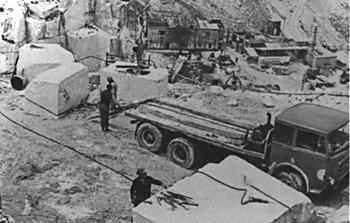
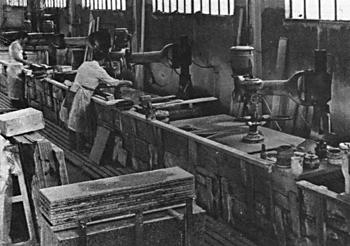
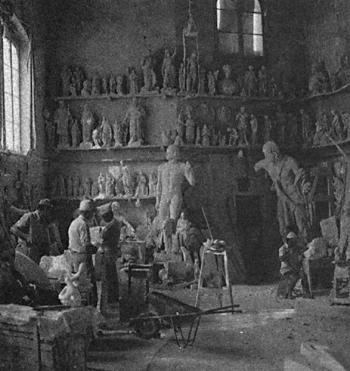
Table 1
Table 2 |
Final marble polishing |
5. Finishes
The large blocks of stone from the quarry are taken to a mill where they are first passed throught a gang saw that cuts them into thick slabs. Power saws (chat saws, shot saws and diamond saws) are then used to cut the slabs into pieces of the required dimensions.
Each piece is then given whatever surface treatment is required to produce the texture specified in the order. In some cases, the surface produced by the saw is all that is required. In other cases, planers, grinders, polishers or hammer and chisel are used to produce the desired texture.
Stones which are to be anchored to the building must be drilled either on the edge or the back, depending on their position. Those that have a special shape are produced by stone carvers, working with a hand-sized air hammer and chisel.
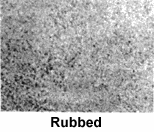
Typical Stone Finishes
 |
|
 |
|
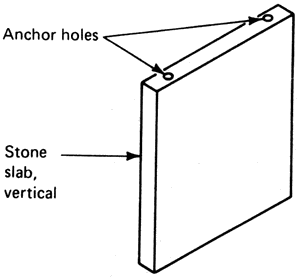
Stones drilled for anchors
Miscellaneous Masonry Products
Fireplace And Chimney Products
1) Flue Linings
2) Dampers
3) Metal Air Circulators
4) Accessories
*Note: MIW currently recommends the information
found in the
Fireplace and
Chimney Handbook
1. Flue Linings
1.1. Clay flue linings are manufactured according to ASTM Designation C 315-78c. Such flue linings are manufactured from fire clay, shale, surface clay, or a combination of these materials that when formed and fired to suitable temperatures, must yield a product that is strong, durable, and serviceable.
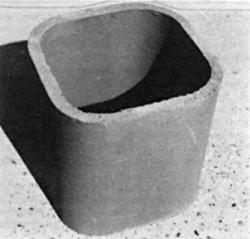
Flue lining
1.11 Clay lining shapes and sizes available in the Northwest.
8" x 8" |
Square, round |
8" x 12" |
Oval |
8" x 16" |
Rectangular |
12" x 12" |
Square |
13" x 13" |
Square |
12" x 16" |
Rectangular |
16" x 16" |
Square |
20" x 20" |
Square |
Clay flue linings are 12 in. high and 5/8" minimum thick
1.2. Pumice flue linings are manufactured to conform to ICBO research report #2602. This lightweight lining is being manufactured in concrete masonry plants.
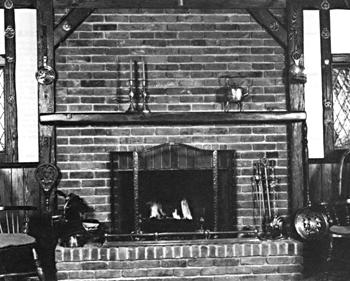
2. Dampers
Dampers (cast iron or heavy gauge steel) are designed to provide two functions: guide the smoke away from the fire and close out energy-stealing drafts when the fire is not lit.
2.1. Standard damper design requires a masonry throat, however permits studding close to the fireplace opening.
2.2. High-form dampers are usually provided with an
extra-wide throat for peak draft possibilities. Such dampers eliminate the need
for difficult masonry construction and permit a deep down draft shelf design
without using additional floor space.
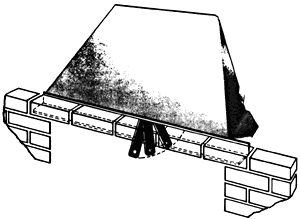
Some high-form dampers close completely to save energy
2.3. Multiple opening dampers are extremely compact. They are especially suited for multiple flue arrangements. In specifying such dampers, conformance to ICBO Report No. 3139 should be required.
2.4. Smoke domes are suggested when less than 3 sides of the
fireplace are enclosed. A smoke dome usually contains a
positive-action tension bar and chain pulls to adjust valve.
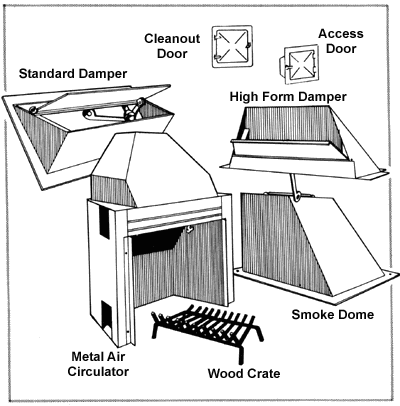
Fireplace dampers, circulator, and accessories
3. Metal Air Circulators
Metal heat circulators are designed to capture and circulate the warm air generated by the fireplace which is otherwise lost up the chimney.
Inlet grilles at the base of unit allow cool air to move from floor through heat chambers where air is warmed and returned to room through outlet grille located at top of unit. Circulating fans may be added to all units for better air movement.
Such units come complete, ready for installation and consist of: firebox, throat, and damper. The firebox is ribbed, has quick heating air flues through the throat to allow greater contact of air to hot metals, and because of large air inlet and outlet, warm air is moved faster.
All exposed metal parts are sealed against exposure by masonry downdraft shelf so nothing can rust. Damper controls on each side govern the amount of outside combustion air.
4. Accessories
For accessories, clean-out doors, ash dumps, outside air kits, chimney hoods, screens, and enclosures consult your local material dealer.
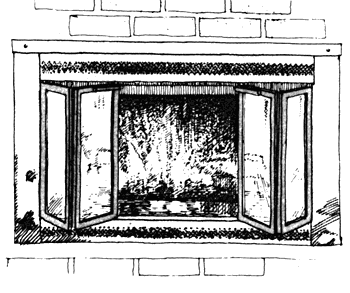
Fireplace glass doors
Components For Mortar And Grout
1) Water
2) Masonry Sand
3) Aggregates For Grout
4) Cement
5) Pozzolanic Materials
6) Lime
7) Admixtures And Colors
1. Water
Water intended for use in mixing mortar should be clean and free of deleterious amounts of acids, alkalies and organic materials. Some potable waters contain appreciable amounts of soluble salts such as sodium and potassium sulfate. These salts may later contribute to efflorescence. Also, a water containing sugar would retard the set. Thus, the water should be fit to drink but investigated if it contains alkalies, sulfates, or sugars.
2. Masonry Sand
The sources of sand can be several. Natural sand is formed by the erosive action of rivers. Such particles are somewhat rounded in shape. They are deposited on flats and on ocean fronts as beach sand. The latter, being subjected to more abrasive wave action, are more rounded. This would make for better workability but probably have a deleterious effect on the strength. Other natural sand sources occur by wind transport, such as blow sand. On the other hand, sand may be manufactured. In this case it would be a product resulting from crushing stone, gravel or blast-furnace slag. This manufactured sand is sharper and more angular and thus may require different amounts of fine cementitious particles to provide the lubrication needed for proper workability. The deleterious substances in sand may be such items as friable particles, lightweight particles, organic impurities or excess amounts of clay or loam. These materials must be removed at the plant before the sand is sent to the job site.
Unfortunately too little concern is often shown for the quality of the sand as expressed in its grading. However the properties of sand have considerable impact upon the workability as well as the strength of the mortar. To provide some sort of guide in this respect, grading limits for mortar sand are spelled out in both ASTM C144 and UBC Standard 24-21. The grading limits from the latter are listed in the tables below.
2.1 Gradation Requirements
Item |
Limit |
• Passing sieve no. 4 |
100 |
• Passing sieve no. 8 |
95-100 |
• Passing sieve no. 100 |
25 max. |
• Passing sieve no. 200 |
10 max |
2.2 Gradation for Masonry Mortar.
(UBC Standard No. 24-21)
Graduation specified, percent passing ASTM C144* |
||
Sieve size No. |
Natural sand |
Manufactured sand |
4 |
100 |
100 |
8 |
95 to 100 |
95 to 100 |
16 |
70 to 100 |
70 to 100 |
30 |
40 to 75 |
40 to 75 |
50 |
10 to 35 |
20 to 40 |
100 |
2 to 15 |
10 to 25 |
200 |
-- |
0 to 10 |
*Additional requirements: Not more than 50% shall be retained between any two sieve sizes, nor more than 25% between No. 50 and No. 100 sieve sizes. Where an aggregate fails to meet the gradation limit specified, it may be used if the masonry mortar will comply with the property specification of ASTM C270 (Table 2). |
||
2.3. Gradation Analysis. Since the quantity of sand required to make 1 cu ft. of mortar may be as much as 0.99 cu ft, the sand has considerable influence on the mortar properties. Masonry sand for mortar should comply with the requirements of ASTM C144 (Standard Specification for Aggregate for Masonry Mortar) for masonry construction. These specifications include both natural and manufactured sands. Sand should be clean, well-graded, and meet the gradation requirements listed above.
Sands with less than 5% to 15% passing the Nos.50 and 100 sieves generally produce harsh or course mortars which possess poor workability and result in mortar joints with low resistance to moisture penetration. On the other hand, sands finer than those permitted by the above specifications yield mortars with excellent workability, but they are weak and porous.
For mortar joints that are less than the conventional 3/8-in. thickness, 100% of the sand should pass the No. 8 sieve and 95% the No. 16 sieve. For joints thicker than 3/8 in., the mortar sand selected should have a fineness modulus approaching 2.5 or a gradation within the limits of concrete sands (fine aggregate) shown in ASTM C33.
2.3.1. Limits of Allowable Sand Gradation
Percentage Retained* (natural sand) |
|||
Sieve Size |
Most Coarse |
Ideal |
Finest |
No. 8 |
5 |
2.5 |
0 |
No. 16 |
25 |
12.5 |
0 |
No. 30 |
30 |
27.5 |
25 |
No. 50 |
30 |
35.0 |
40 |
No. 100 |
8 |
14.0 |
20 |
No. 200 |
2 |
8.5 |
15 |
*Fractional percentage retained between sieves, not total percentage retained. |
|||
Established tests and experience prove that good gradation reduces separation and bleeding. It also improves water retention and workability.
2.4. Deleterious Substances. Deleterious substances such as clay and lightweight particles with a specific gravity of less than 2.0 must not be present in harmful quantities. While these materials often will not affect the plastic properties of the mortar and may even improve workability and plasticity, they usually have a detrimental effect on the mortar's strength and durability. The table below shows potentially harmful materials that may be contained in a mortar sand and includes references to ASTM tests that can be used to determine the presence of injurious amounts of such material.
2.4.1. Deleterious Substances
Material |
Effect on Mortar |
ASTM Test |
clay |
affects workability, durability, strength and may cause popouts |
C-142 |
lightweight materials (coal, lignite,and others) |
same as above |
C-40 |
organic impurities |
affects setting and hardening,may cause deterioration and discoloration |
C-40 |
silt and powdered clay |
affects workability, durability, and strength |
C-117 |
2.4.2. Alkali-Aggregate Reactivity. There is also the possibility that the sand itself may be chemically reactive with cement or lime, a phenomenon called alkali-aggregate reaction, which may cause abnormal expansion and cracking. Experience records of the sand source usually provide the information needed for the selection of nonreactive aggregates. If a sand is suspected of being chemically unstable and there is no service record, it can be tested for suitability. The American Society of Testing and Materials has two tests and a recommended practice for identifying alkali-reactive aggregates.
The Method of Test for Potential Alkali Reactivity of Cement-Aggregate Combinations, ASTM C227, commonly called the mortar bar test, measures the expansion developed in small mortar bars during storage under prescribed moist conditions. A disadvantage of this test is that three to six months may elapse before conclusions can be drawn.
In the Method of Test for Potential Reactivity of Aggregates (Chemical Method), ASTM C289, known as the quick chemical test, the degree of reaction between a sodium hydroxide solution and a specimen of sand is determined. Conclusions can be reached in two or three days.
Another laboratory method of identifying reactive substances is the Recommended Practice for Petrographic Examination of Aggregates for Concrete, ASTM C295. This involves microscopic examination of sand particles by a qualified petrographer.








Site Map
e-mail roger@mastermasonry.com
About Us
Master Masonry has a deep concern for your complete satisfaction of our repairs.
As a second-generation mason, Roger Landry has been performing brick and stone masonry since 1970 when he began as an apprentice to his father.
In addition to being a Master Mason, Roger is a decorated Air Force veteran with a 22 year active duty career.
When it comes to trust, dependability and a very high degree of character, you can count on us to stand behind our work and our word.