Call Today
214 226-6007

Brick Repair
Mortar Cracks
Arch Entry Repair
Chimney Repair
Water Leaking thru Bricks
Masonry Cleaning
Sealing
Expansion Seams
Free Estimate
History/Researh
Links

Masonry Cleaning and Sealing.
It's hard to imagine that anything as small as a drop of water could wreck havoc on something as solid as a brick and mortar, a piece of stone or a slab of concrete. But constant exposure to water, and especially to winter's freeze and thaw cycles, can damage or destroy masonry surfaces in a surprisingly short amount of time.
The answer is to seal the masonry's porous surfaces against the intrusion of water. For most masonry surfaces - brick, stone or ceramic tile - a masonry sealer is the proper choice. Depending on the type of masonry sealer, some will also work to seal concrete slabs. The sealer also helps to protect against buildups of dirt, oil, grease and markings from automobile tires. Masonry sealers are not intended for use on asphalt, glazed ceramic tile or on wooden surfaces.
Sealers also come in different surface "sheens." depending on the look you want. While all of them are clear, some types dry to a completely flat sheen and leave the surface looking unsealed. Other types dry to a glossy "wet" look, and the depth of the gloss increases with each application. There are also semi-gloss sheens that are in between flat and glossy. The choice of how glossy you want the finished surface is typically one of personal preference - however, with some types of sealers the glossier the product is the more abrasion resistant properties it has.
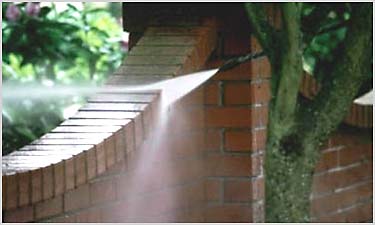

In general, the surface to be sealed has to be clean and dry. This may involve pressure washing with soap and water or with a degreasing chemical, or simply sweeping it off with a broom. If you clean the surface with water, or if it rains between the time you clean it and the time you are ready to apply the sealer, remember that the surface must be absolutely dry before you start putting on the sealer - sealing over a wet slab is the most common reason for failure of the sealer.
Cleaning brickwork. During the life of a building its brick walls may need to be cleaned on several occasions, the first occurring even before it goes into service when the general dirt and dust of construction, including mortar splashed or smeared on the bricks as a result of the bricklaying procedure, have to be removed. A second cleaning will sometimes be necessary to remove efflorescence. Because mortar must be wet to render it plastic for bricklaying, brickwork becomes damp in the course of construction. As it subsequently dries, the moisture, in which the various salts derived from mortar and bricks have been dissolved, moves to the wall surface to evaporate, leaving a deposit of salts, usually as a white coating on the bricks.
When the brick walls will next need to be cleaned depends on the amount of soiling they receive in service, and this is governed by the nature of the atmosphere to which they are exposed. A brick farmhouse, for example, may well retain its original appearance over a century of service because of a relatively unpolluted atmosphere. In contrast, the brick walls of a building located in an industrial area with a highly polluted atmosphere may be dirty after only a decade or so of service. This Digest presents basic information on methods of cleaning brick walls and outlines some of the problems that can be encountered.
Other Reasons for Cleaning Brickwork. The need to clean brickwork may arise from many causes other than those resulting from atmospheric pollution: stains from metals, particularly iron and copper used in conjunction with brickwork, and growth of lichens, moss and other vegetation. Cleaning may be necessary to remove efflorescence that forms as a result of excessive dampness resulting from some abnormal local condition, for example, spillage of water from a defective drain or rising dampness from earth in contact with the wall.
Brickwork that has been painted may not be aesthetically pleasing at a later date. Accidental spills of tar and asphalt, such as result from carelessness in making roofing repairs, or the intentional soiling of walls by vandals provide additional reasons for cleaning brickwork. Discoloration of the brick walls of old buildings by the tarry material that sometimes forms in chimneys built into the walls (and eventually finds its way through the bricks) can provide yet another.
Test Cleaning. Before it is decided to use a particular method or even to have brickwork cleaned, it is useful to clean a relatively small area in order to assess the efficiency of the method and the resulting appearance of the brickwork. The area selected for test should be inconspicuous in case it is decided not to proceed with the cleaning. The results will not only provide an indication of the effectiveness of the cleaning procedure but may also reveal harmful effects on the bricks and mortar. If the wall is wetted after the test and allowed to dry thoroughly, possible contamination with efflorescence from the cleaning material may be revealed.
Useful information about a particular cleaning process can also be obtained by examining buildings on which it was used. Cleaning firms can provide examples of their work, of which as many as possible should be examined.
Because of the great diversity in the nature of the dirt that forms on brickwork and in the properties of the bricks and mortars affected by it, it is frequently necessary to try several cleaning methods before a suitable treatment can be found. For certain specific types of dirt and stain, however, the remedies given below are usually effective.
After Cleaning. The main consideration in cleaning brickwork is usually its improved appearance, but another benefit may often be the uncovering of faults such as cracks and decayed material that should be repaired. In addition, repairs are best made to a clean wall, particularly if one wishes to obtain a good color match between new and old work.
Conclusions. Cleaning of brickwork at regular intervals is desirable as a means of prolonging its life, and it is often wise to establish a definite schedule of cleaning. Simply washing with water and scrubbing lightly at intervals of two or three years is frequently all that is necessary to maintain it. various cleaning materials and methods are available, but in making a selection consideration must be given not only to the effectiveness of the method but also to the hazards involved and to possible adverse effects
Call Today
214 226-6007
e-mail roger@mastermasonry.com








Site Map
e-mail roger@mastermasonry.com
About Us
Master Masonry has a deep concern for your complete satisfaction of our repairs.
As a second-generation mason, Roger Landry has been performing brick and stone masonry since 1970 when he began as an apprentice to his father.
In addition to being a Master Mason, Roger is a decorated Air Force veteran with a 22 year active duty career.
When it comes to trust, dependability and a very high degree of character, you can count on us to stand behind our work and our word.