Call Today
214 226-6007

Brick Repair
Mortar Cracks
Arch Entry Repair
Chimney Repair
Water Leaking thru Bricks
Masonry Cleaning
Sealing
Expansion Seams
Free Estimate
History/Researh
Links

History of Brick Masonry
1) Development Of Brick.
2) Steps In The Manufacturing Process.
3) Brick Today
4) Properties Of Brick
5) Characteristics And Shapes
1. Development Of Brick
Brick is one of the oldest manufactured building materials. Ancient records and excavations show that brick construction dates back more than 5000 years. Brick making was a highly respected skill in early civilizations. Many old masonry walls bore evidence of royal support for the craftsman who made the bricks. Royal seals and the names of kings were stamped in some of the bricks.
One of the earliest types of brick was adobe brick. These brick contained straw for greater strength, just as reinforcing wire is used in concrete to give it strength in modern construction. After the adobe brick were molded into shape, they were placed in the sun to dry. Adobe brick are still used in a few countries today.
After the sundried adobe brick had been in use for some time, it was discovered that a brick subjected to fire in a closed area such as a kiln, or oven, for a definite period of time became very hard and highly fire resistant. The fired brick resisted weather and the passage of time far better than unfired bricks. Some of the brick were coated with a thick enamel or glaze. The glazes were commonly red, yellow, green or a combination of these colors. When subjected to heat in the kiln, the color hardened and possessed a glass-like finish. Some of these glazed brick, recovered from old buildings, still retain their original color after 2000 years. Glazed brick are made today but have limited use since they are costly to manufacture.
In the past, the mason usually made the brick he was later to lay in the wall. Many of the brick made in ancient times had a recessed panel known as a frog. When mortar was forced into the frog, the brick had a stronger bond in the wall being constructed. The craftsman who made the brick also used the frog as a place to mold letters or inscriptions to identify himself or the job on which the brick was to be used.
The making of brick was regarded by many of the old world craftsmen as a secret process. Brick masons were one of the first groups of craftsmen to form an organization to keep these processes secret and confined to their own group. These specialized organizations were called guilds and were the forerunners of modern unions.
In 1666 a great fire changed London, England from a city of wooden buildings to a city of brick construction. The manufacture of brick attained a high degree of excellence and dominated the building field in this period of history.
Early records indicate that the first brick manufactured in the United States were made in Virginia in 1611 and in Massachusetts in 1629. The brick were made by hand using very simple methods and tools. Many of the brick used in construction in the early American settlements were brought from England as ballast in sailing ships. Some of these brick can still be found in the foundations and walls of the remaining original houses in the eastern part of the United States.
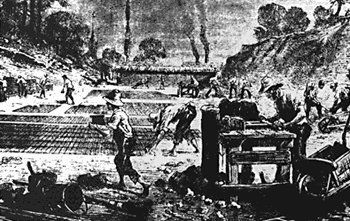
The invention of the steam engine in England in the year 1760, and the subsequent Industrial Revolution, brought a change from manual labor to the use of power-driven machinery to make brick. This change started the true development of the brick in dustry in America. The first brick-making machine was patented in 1800.
Technological developments during the last century have helped to make the manufacture of brick a very efficient and highly productive process. More complete knowledge of the characteristics of the raw material, improved kiln designs, controlled heat in the kilns, and extensive mechanization have all played an important part in modernizing brick manufacturing.
The modern brick plant meets the challenge of increasing production, while retaining a high quality for the final product, by using computerized manufacturing methods and highly skilled workers.
Basically, brick are made by mixing water with finely ground clay or shale or a combination of both. The mixture is then formed into the desired shape, predried, and burned in a kiln for a predetermined time.
While the basic steps of brick manufacturing are standard throughout the industry, each brick-making plant has minor variations to these steps due to local conditions. For example, one brick plant may be near the source of the raw material, while another plant may have to truck or rail the material in from a distant source. These two plants will have different ways of obtaining and stocking their raw materials.
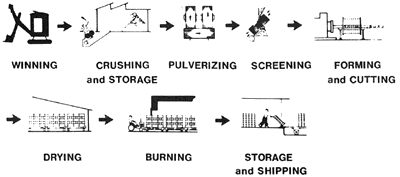
Manufacturing process diagram
2. Steps In The Manufacturing Process
The manufacturing process has eight maior steps taking the raw material from
the ground, or winning; preparing the raw material for use; forming the
material into brick units; predrying the units; burning the brick in the kiln
under controlled heat; and drawing and storing the brick. All other operations
of making brick stem from these eight major steps.
2.1. Taking the Material from the Ground. The removal of the raw material from the ground is called winning. Power equipment is used to mine surface clay and shale in open pits. Trucks or railways bring the material to the storage piles
Enough raw material is stored to assure plant operations for several days in the event that bad weather halts mining and/or shipping operations. Several storage areas are provided so that the clay and shale can be blended to yield material with a better composition. Blending produces more uniform raw material, helps control the color of the finished product, and permits some control over providing raw material suitable for manufacturing a given type of brick unit.
2.2. Preparing the Material. If the raw material is in large lumps, it may be crushed before it is placed on the storage pile. The crushing breaks up the large pieces and removes the stones. Following this, 4- to 8-ton grinding wheels revolving in a circular pan grind and mix the material. It then passes through an inclined vibrating screen which controls the particle sizes. The finely ground material is taken by a conveyor belt to the site where it is formed into single brick.
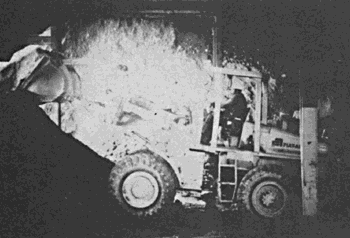
Raw material is stored to assure operations for several days.
2.3. Forming the Clay or Shale into a Brick Shape. Three methods of forming are us ed in the production of bricks: the stiff-mud process, the soft-mud process, and the dry-press process.
Stiff-Mud Process. The most frequently used process at present is the stiff-mud process. It produces a harder and denser brick than is obtainable from the other processes. A greater volume of brick can be manufactured by this method to meet the growing demands of the construction industry.
The first step in the stiff-mud process is to add water to the raw material to make a plastic, workable mass suitable for molding. The mixing is done in a machine called a pug mill. The pug mill has a mixing chamber which contains one or two revolving shafts which thoroughly mix the raw material and a measured amount of water.
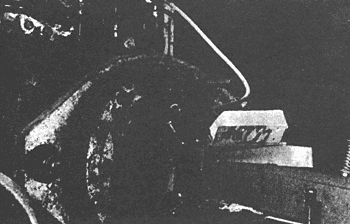
The stiff mud process is done in a brick
machine which consists of a pug mill,
a de-airing chamber, and an auger extruder
After the mixing is completed, the pugged clay is forced through an opening called a die, a process much like toothpaste being forced from a tube. The long, formed ribbon of brick being extruded through the die is called the column. As the column moves away from the die, it is cut into lengths which are either the height (side cut) or length (end cut) of the brick. The cutting is done automatically by a large circular wire cutter which cuts each brick to the same size. These green brick (brick in their soft condition before they are burned in a kiln) are then placed on dryer cars.
Soft-Mud Process. This is the oldest way of making brick and was used before brick-making machines were developed. Automated machinery is now used in this process.
The soft-mud process is suited for clays which contain too much natural water for the stiff-mud process. The clay is mixed with twice as much water as in the stiff-mud process and is pressed into wooden molds. The molds are lubricated with sand or water so the clay does not stick to the mold. When sand is used to lubricate the molds, the bricks are sand-struck and have a sandy finish. When water is used, the bricks are water-struck and have a very smooth finish.
Dry-Press Process. In this process, the clay is mixed with a small amount of water as compared to stiff mud and is then forced into steel molds under very high pressure. This method is not in wide use now in the U.S.A., but some are produced in the Pacific Northwest. There is less demand for pressed brick because of its selected use and the high cost of manufacturing.
2.4. Predrying Brick Before Burning In the Kiln. Excess moisture must be removed from the brick before they are burned in the kiln. Years ago, brick were allowed to dry in the open air before they were placed in the kiln. The modern method is to predry the brick in the forward section of the kiln using the waste heat from the hot section of the kiln. The heat and humidity must be regulated carefully to prevent sudden changes in the temperature which will cause excessive cracking and deformation of the brick. The drying time in the kiln is greatly reduced from that of the open air process. In other words, with the brick being dried in the kiln, the weather is not a factor affecting the moisture content of the brick. The brick are placed in the drying chamber on special, rolling steel cars and are left there for a predetermined drying time before they move into the hot section of the kiln. The temperature in the drying area is 100 to 400 degrees in Fahrenheit.
2.5. Burning the Brick in the Kiln.
The burning process is one of the most specialized steps in the manufacture of
brick. Kilns have changed drastically over the years. Since brick making emerged
as an industry, three basic kilns have come into use: the scove kiln, the
beehive kiln, and the tunnel kiln.
The Scove Kiln. The scove kiln, was the first kiln to be used to burn brick. There are very few of these kilns in use today. The unburned brick were stacked in piles inside the kiln which was then plastered on the outside with mortar to lock in the heat during the burning process. Openings were left in the bottom walls of the kiln where hardwood fires (in later years, gas and oil) provided heat for the kiln. This method was not very efficient since the brick nearest the fires were burned hard, while those near the top of the kiln were soft and could be used only for filler walls or interior construction.
The Beehive Kiln. An improved kiln, the beehive kiln, came into use after the scove kiln. The beehive kiln is a round brick structure wrapped with steel bands to control the expansion caused by heating the kiln. The brick to be burned are stacked in the kiln with narrow spaces between them so the heat will pass completely around them. The kiln is sealed by walling the doors shut with brick and mortar. The heat may be applied either from the bottom or the top. When these kilns first came into use, wood and coke were the main sources of heat. Gradually these fuels were replaced by gas and oil because they could be controlled and regulated more efficiently. The beehive kiln requires quite a bit of time to burn the brick. As a result, this type of kiln yields a limited amount of brick.
The Tunnel Kiln. The most modern kiln is the tunnel kiln which is built of brick and lined on the inside with fire brick. The brick to be burned are stacked on flat cars which move very slowly through the kiln. The cars move from the predrying section of the kiln into the burning section.
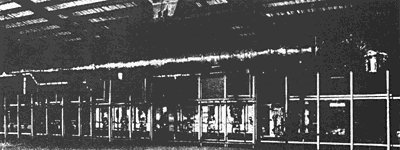
The most modern kiln is the tunnel kiln where a
temerature of 1950 degrees F or more can be reached
The average time for the unit to pass completely through the kiln is about 36 hours and is controlled by computers. The numbers of brick on a car is rather small compared to the number of brick stacked in the older types of kilns. The cars, however, pass through the tunnel kiln continuously and the brick all receive the same heat treatment, resulting in a more uniform product.
The heat in the kiln is supplied by gas, oil or powdered coal. The heat gradually increases as the brick pass from the kiln inlet to the firing zone in the center of the kiln. This is where the greatest temperature is reached, an average of 1,950 degrees Fahrenheit. From the center of the kiln, the brick move to the outlet. As they move from the center, the heat is reduced slowly to eliminate cracking, pitting, and other problems which are due to a rapid reduction of temperature.
It is very important that the rate of temperature change in the kiln be controlled during the burning operation. Tunnel kilns are equipped with recording instruments which provide a constant check on the temperatures in the kiln.
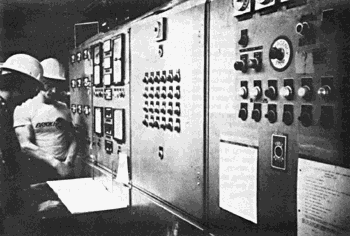
Control center for the tunnel kiln
While the brick are still in the kiln, they can be given a treatment called flashing. Flashing means that the amount of oxygen used in the burning is reduced. The flame changes from red to blue. This changes the oxidation rate of the kiln which, in turn, causes the brick to take on varying shades of color. The type of clay or shale in the brick determines how the brick reacts to flashing.
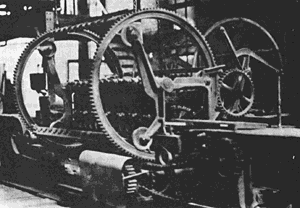
In the stiff-mud process cutting is done
automatically by a large circular wire cutter
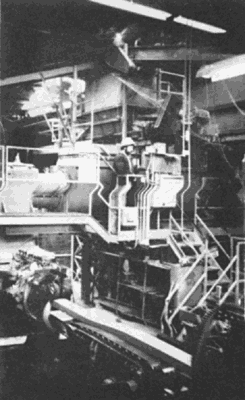
From extruder to the automatic wire cutter
2.6. Removing the Brick from the Kiln.
Drawing is the process of removing the brick from the kiln. The brick leave the kiln on the cars which are placed in a holding area for a period of time un til the brick are cool. Then the brick are removed from the cars and placed on pallets for storage.
It is true that modern masons no longer manufacture the brick they use as their forerunners did many years ago. The modern brick is a superior product due to the high degree of manufacturing quality control that is used. Much of the guesswork and trial and error methods of the past have been replaced by scientific processes and computerized manufacturing.
3. Brick Today
The term brick as used today denotes a solid masonry rectangular unit formed in a plastic state from clay and shale and burned in a kiln. The United States Federal Trade Commission has ruled that no product made from materials other than clay or shale can be called brick, unless the name includes the material from which the unit is manufactured, such as cinder brick, sand brick, sand lime brick, or concrete brick.
Raw Materials. Clay and shale are the principal materials used to make brick. Usually concentrated in large deposits, these materials are found all over the world.
Clay is a natural product which is formed by the weathering of rocks. Shale is made in very much the same way from the same material but is commpress ed into layers in the ground. Shale is very dense and is harder to remove from the ground than clay. As a result, shale is a more costly raw material.
Two or more kinds of clay and shale may be mixed together to obtain a material having the proper consistency and composition.
There are several forms of clay that have a similar chemical composition but different physical characteristics.
Surface clays are found near the surface of the earth. They may be offshoots of old deposits or the result of more recent weathering of rocks.
Shales are clays that have been formed under high pressure, by natural conditions, until they resemble slate.
Fire clays are mined from a greater depth than are the other clays, resist higher temperatures and have a greater resistance to heat shock. They contain fewer impurities than shales or surface clays and have more uniform chemical and physical properties.
Although surface clays and fire clays differ in physical structure from shale, the three types of clay are chemically similar. All these are made of silica and alumina with varying amounts of metallic oxides and other impurities. Metallic oxides act as fluxes and promote fusion at lower temperatures. The amount of iron, magnesium, and calcium oxides in the clays influences the color of the finished product. The material from each deposit of clay and shale has chemical characteristics which may be uniform for that deposit but may differ from the characteristics of material in other deposits. The changes in characteristics from deposit to deposit are due to differences in the relative amounts of the chemical components. As a result, brick made from the material in one deposit will have one set of characteristics for color, finish, and texture, while brick made from material in another location may look different because the chemical composition of the material varies slightly from that at the first location. In addition, all clay and shale do not react in the same manner to processing methods.
4. Properties Of Brick
All properties of structural clay products such as brick are affected by the composition of the raw materials used and the manufacturing process. Basically, important properties of brick are color, texture, size variation, absorption, compressive strength, and durability, Most burned brick is fireproof regardless of the other properties mentioned in this unit. Due to the technical nature of brick properties, they will be generally discussed.
4.1. Color. The chemical composition of the natural clay and the minerals which may be added to the natural clay determine the color of the finished brick. Another factor which affects color is the temperature at which the clay is burned and how well the temperature is controlled in the kiln.
Of all the natural oxides found in clays, that of iron has the greatest effect on color. Regardless of its natural color, clay that has any iron in it will burn red due to the formation of ferrous oxide, If the finished product is to have a darker color, the clay must be burned at a higher temperature.
Architects and builders can add to the architectural beauty of modern brick buildings by choosing from the range of colors in which brick are available.
Since there may be some differences in the bricks from different burnings, it is advisable to buy enough brick for a job at one time.. In this way, the mason has a sufficient quantity of brick in the proper color to complete the job. Any excess brick can be used for repairs.
4.2. Texture. Texture in brick is the arrangement of the particles of raw materials in the brick and the appearance and finish of the brick. For example, a hard, smooth brick has a fine finish or texture, while brick that has a sand finish is said to have a coarse texture. These finishes are the result of the type of process used to make the brick. In the stiff-mud process, many textures can be obtained by using attachments which cut, scratch, roll, brush, or otherwise roughen the clay column as it leaves the die. Shown are several different brick textures commonly available, Wire cut, deformed, and rug face brick are all brick that have a rough face of irregular design to suit any job. These brick are popular for fireplaces and buildings in which the builder wants to show a bold course design in the finished lob. Old brick are often used to obtain this special effect. However, the quality of the old brick is an important factor, since they may deteriorate rapidly when used on an outside wall.
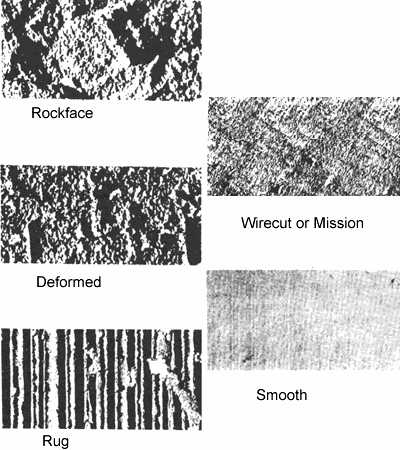
Figure 1 - Brick textures available in the Northwest
The treatment of mortar joints is a definite form of texture and affects the final appearance of the wall. The same kind of brick can be used to build a wall but different ways of finishing the mortar joints will create various textures in the wall. A wall using recessed and projected brick achieves a different texture due to the resulting shadow and highlighting effects. The use of colored mortar gives the wall added texture and warmth. The texture of the wall should always be considered so that it will blend in with the architectural design of the building and its surroundings.
4.3. Size Variation. Clays shrink during the drying and burning processes. Therefore, allowances for shrinkage must be made. Since air shrinkage and fire shrinkage vary for the different clays, the burning process requires careful control based on testing and experience.
Fire shrinkage increases as the temperature of the burning area increases. Since darker colors are obtained at a higher burning temperature, some differences between the sizes of dark and light brick should be expected. To assure uniform size in their brick, manufacturers work very hard to control the factors which cause shrinkage. Because of the differences in raw materials and temperature variations in the kilns, absolute uniformity is impossible. However, the specifications (written details or a description) for brick types indicate the desired size as a range of permissible to allow economical manufacture.
4.4. Absorption. Absorption is the weight or amount of water a masonry unit absorbs at certain conditions for a stated length of time. This weight is expressed as a percentage of the weight of the dry unit.
4.5. Compressive Strength. Compressive Strength is defined as the resistance a brick has to increasing loads or stress placed on it before it breaks. Run on brick used must be first tested to determine its strength.
Both the compressive strength and the absorption of a brick are affected by the properties of the clay, the methods of manufacturing, and the burning process. Although there are exceptions, brick produced by the stiff-mud process have higher compressive strength ratings and lower absorption rates than units produced by the soft-mud or dry-press methods. These are additional reasons why the stiff-mud process is used more than any other method of manufactu ring
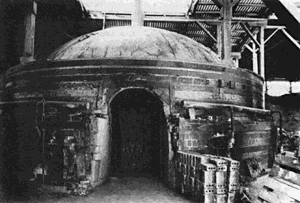
The beehive kiln
yields a limited amount of brick








Site Map
e-mail roger@mastermasonry.com
About Us
Master Masonry has a deep concern for your complete satisfaction of our repairs.
As a second-generation mason, Roger Landry has been performing brick and stone masonry since 1970 when he began as an apprentice to his father.
In addition to being a Master Mason, Roger is a decorated Air Force veteran with a 22 year active duty career.
When it comes to trust, dependability and a very high degree of character, you can count on us to stand behind our work and our word.